A tour of the app
Every screen, one at a time, with what it does and a free guide for each. The student shown is illustrative.
Your profile
Tell Stratia everything. Then see yourself whole.
The thing you loved at ten. The certificate in a drawer. The club that is not on any transcript. Type it, photograph it, or just tell Astra, and it all lands in one record. The Read tab shows you what an admissions reader would see: you, on one page.
Your year
The app meets you at your year.
The same journey re-paces to whoever shows up. A freshman gets the four-year head start; a senior gets this season's moves, with the phase card at the top of the app. Steps check themselves off from your real data, a saved list or odds actually computed, never for just visiting a page.
The engine
Watch the read happen.
Your record in, the school's own published bar beside it, and the plan out. The same inputs always give the same read, shown here with UCLA's real numbers.
What each school weighs
See what each school actually weighs, and where you stand on it.
Every college publishes what it counts and what it ignores. Stratia reads that from the school's own Common Data Set, puts your record beside it factor by factor, and tells you which bars you already clear, before you spend a season on the wrong thing.
Majors before schools
Map your majors before you pick schools.
Most students default to the same crowded majors everyone applies to, and quietly hurt their own odds. Stratia maps the majors your record actually supports first, then suggests the activities that strengthen that direction.
Build
File a patent
It starts from what your profile already shows. Brainstorm's seven questions, answered in your own words, become a write-up with every sentence traced to something you said, and a search of the public record shows you what already exists, for you to decide. Then the application, with figures, and the walk through filing it yourselves. Part of the Season Pass.
What your student ends up with
Brainstorm, file a patent, write a paper, practice a pitch: one idea, three things a reader can check.
Your interview
1The problem you noticed"On Saturday shifts the wheelchairs at discharge wait on whoever is nearest. Nothing says the request exists."2Who has it3What people do about it today4What you would build5How it works, step by step6What would go wrong7What you have triedsaved as typedThe seven answers
1 Brainstorm
Seven questions with Astra. Your answers, saved as you typed them.
A write-up where every sentence shows which answer it came from.
Then, in any order
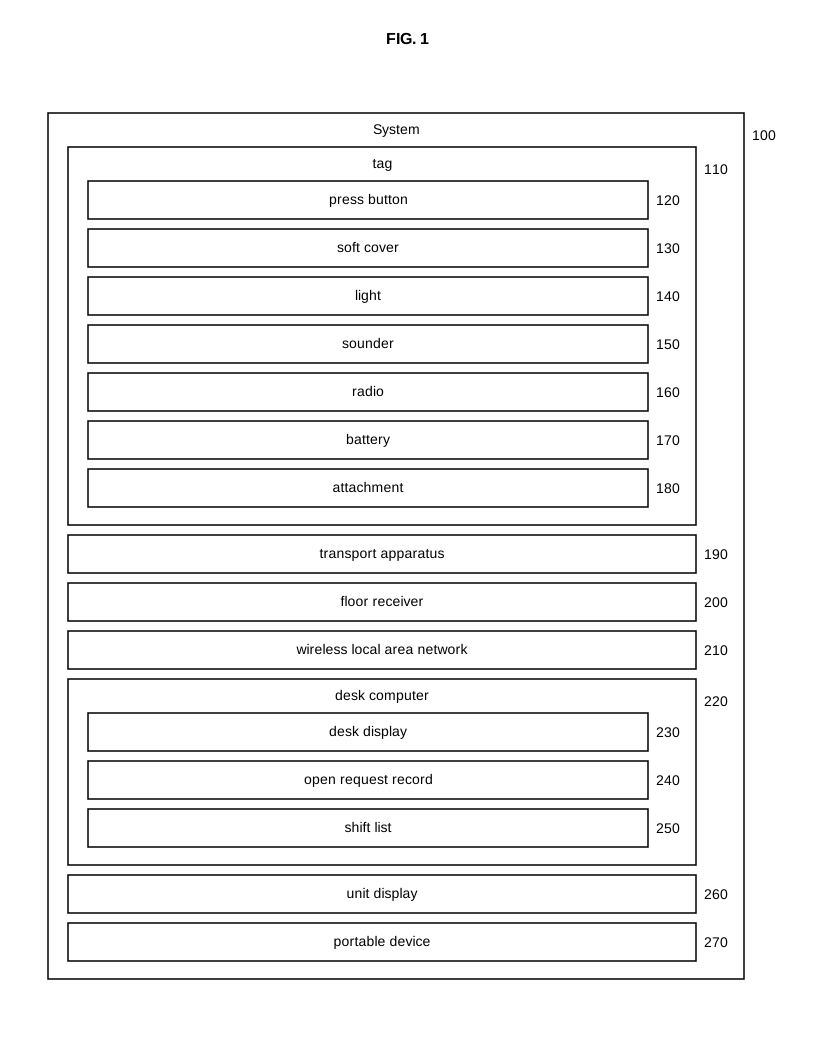
FIG. 1 of the specification
File a patent
A prior-art search you decide, a specification with figures, the filing walk.
An application number and a filing date. "Patent pending" only once the receipt exists, then on your activities list, worded as filed.
Review, round 1
Rubric row: methods, number of trials
"We ran the timing trial three times because that seemed like enough."
What the mentor found
The plan you locked names five trials per condition. The paper reports three.Its question
How did you decide the number of trials to do?requiredOne review item
Write a paper
A mentor that asks and never authors; a paper with the log to prove it.
The log of every question the mentor asked, exported as the contributions statement journals and fairs ask for.
- Wheelchair requests at discharge go to whoever is nearest.From your answer to question 3, what people do todayScript: "Every Saturday I watch the same thing happen at the discharge desk..."slide 2 of 90:41 / 1:00run 3
The presenter view
Practice a pitch
The same answers as a sourced deck; rehearsed out loud, three fixes a run.
The deck with a source on every line, and every run's numbers.
A sample: a patient-transport tag, a test invention run through the patent steps this week. The answers and the review item shown are sample text; every feature in the specification traces to an answer the inventor gave; nothing was invented to fill a gap.
Why it counts on a college application
- The most selective colleges rate what you did outside class. In Harvard's reading procedures, entered into the court record, a 1 is "national-level, professional or other truly unusual achievement". 24% of applicants were rated 1 or 2 on extracurriculars, against 42% on academics. Strong grades are common; something checkable is not.The federal court record, via Patent Pending on a College Application
- The filing has a number and a date. Listed as "filed a U.S. provisional patent application", patent pending, it stands through every deadline; the twelve months to convert run past decision day, so the family decides then.USPTO; the resources paper
- A paper alone does not carry; the account of who did what does. Admissions readers told ProPublica in May 2023 they "can't tell if a paper in the sciences means anything", and MIT's dean said the office weighs "the mentor's recommendation". The paper step's log is that account, in the five lines Regeneron STS asks for.ProPublica, May 18, 2023; MIT Admissions; STS 2027 Project Recommendation
- The journals set the bar, and the paper step is built to it. JEI charges $49 per submission and requires an adult senior mentor as the last author; ISEF requires the plan and its approvals before experimentation starts. The plan is locked before the data step opens.JEI submission pages; ISEF 2026-27 rules
- The number is the proof; the story is what readers score. The pack starts from your student's own record, so the invention, the activities list and the essay tell one story.
Do the right things
Activities chosen from your record, not someone else's checklist.
Tell it what you enjoy and it reads your transcript and activity list, names your spike out loud, and suggests the activities that deepen it. Each comes with the why, the commitment, what it builds on and a first step this week. Every idea can land on your roadmap with a date.
Your list
Build a list that's balanced, not hopeful.
Every school in the catalog is scored against your profile and your intended major, with program impaction and in-state rates folded in, then sorted into honest reach, target and safety. The card says why, inline, with nothing to click.
Summers
A summer that deepens your story.
A hand-verified catalog of 269 summer programs: real deadlines, cost and selectivity stated plainly, each matched to your major, your activities, whether it pays, and whether your academics put it within reach.
What really happened
See what happened to students like you.
24,000+ decisions reported by real applicants: GPA, SAT, APs, the round they applied in, and what the college decided. Self-reported, so it is illustrative, and compared with your own record school by school.
Your story
Essays, step by step, in your own voice.
The Essay Workshop takes you from a blank page to a finished draft: guided questions to find what to write about, starters built from your own story, and honest feedback as you revise. The coach never writes sentences for you.
Execution
A roadmap that paces itself to you.
Every dated item sits on one graduation-anchored line: tall stacks are busy days, and deadline-heavy days turn red. It tells you which items close a door if missed, in exactly those words, and a weekly email says what is coming up.
Astra
She reads everything. Before every answer.
Astra is the college counselor built into Stratia. Before she answers, she has read your whole record, 24,000+ real admission outcomes and 7,000+ majors. She does the work in the app, and she asks before she changes anything.
Your team
Bring your people in, on your terms.
A counselor, a parent, a mentor: each gets a private link by email, no account needed, scoped to exactly the sections you choose. You see how often they looked and when, and revoking is one click.
Your apps, connected
Bring your favorite apps. They get real access.
Connect Stratia to Claude, ChatGPT or another assistant you already use, in one step. It reads your real record and can act on it, saving research straight back into the app. Astra needs no connecting: she is already inside.
Guides
Answers, ready when you are.
Free guides on how admissions actually works and how Stratia reads it, no account needed, each with its read time up front.
Browse the guides